
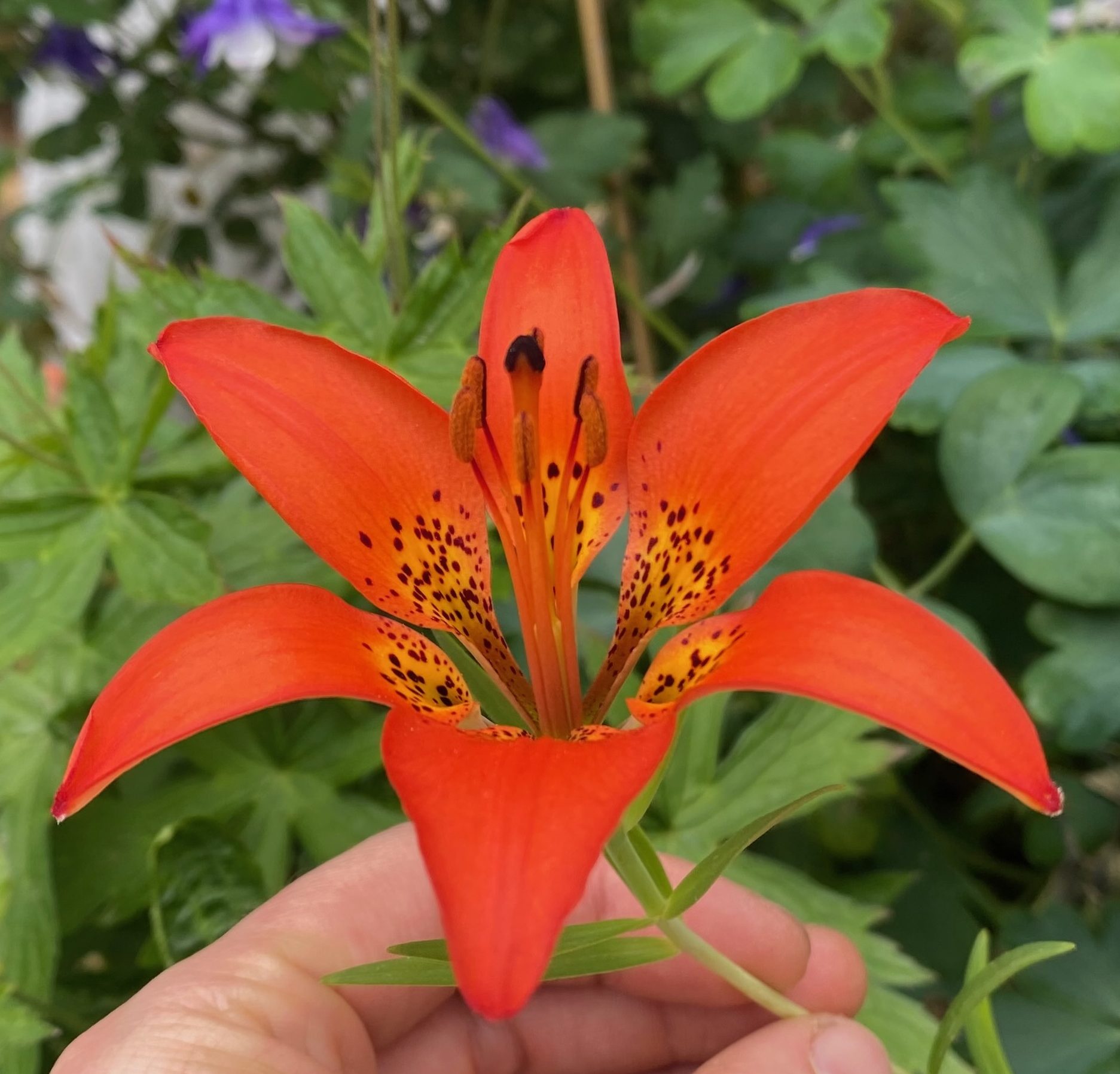
Prairie Moon claims that prairie lily (Lilium philadelphicum)—also known as “wood lily”—takes five years to mature and flower.1 Well it’s been seventeen months (520 days, to be exact) since I sowed my prairie lily seeds, and I have my first prairie lily flower (see figure 1). Most of my prairie lilies will wait their third season to flower, but some are blooming their second season. So at least in my carefully controlled growing conditions, prairie lily can be raised to flowering age in well under five years. For all the readers out there who are interested in growing this beautiful native lily, but are daunted by the thought of waiting half a decade, I’m here to tell you that you don’t actually have to wait that long!

Prairie lily was once abundant in the mesic prairies of south-central Wisconsin, but only about 100 acres of the original 800,000 acres of mesic prairie remain in Wisconsin, and with that habitat loss, prairie lily has become much rarer on the landscape. Many prairie restorations in Wisconsin are on mesic soils (typically farmland converted to prairie), but I don’t see many prairie lilies on these restorations. Although I don’t know of any formal research on individual or population survival of prairie lily in restorations, there are a variety of reasons that prairie lilies may struggle to survive:
- Animals preferentially dig up and eat their delicious bulbs
- Animals preferentially browse their delicate stems and leaves
- Taller, more aggressive plants outcompete and smother them
- They have relatively short lifespans, so need to successfully reproduce frequently to maintain a population
When it comes to growing prairie lily from seed, germination is easy and straightforward, but ensuring their survival to flowering age is a little trickier. I’ll briefly describe my experiences germinating these seeds, and then share my thoughts on getting them to flower.
How to germinate prairie lily seeds
Prairie lily is very easy to germinate; my protocol yields germination of about 90% and requires only nine weeks of cold stratification (and I bet you could get away with less time in the fridge).

Although I typically use a 20/10°C temperature regime when sowing these seeds (read more about temperature regimes here), prairie lily also germinates well at room temperature (approximately 20°C), which makes it a good choice for those who don’t want to mess around with precision temperature control. I’ve also tested its germination with a 15/6°C temperature regime, and I did get some germination, but it was much slower (see table 1).

How to ensure your prairie lily seedlings reach maturity and flower
I strongly advise against planting out prairie lilies that are less than eight inches tall (a height they typically achieve after one dormancy cycle).2 I’ve tried planting ten-week seedlings (which were mostly single cotyledons, or just a few basal leaves), and they all died. I’ve also tried planting out five-month seedlings (see figure 3), and those also died. So patience is key; do not rush to plant these out! Young plants are very small, and highly prone to being smothered by their neighbors.
I don’t yet have a number for exactly how long they take to reach transplantable size. Conventional wisdom is that these should stay in the greenhouse for at least two years, but I’m assuming that’s in an unheated greenhouse (so two years is 10 to 12 months of active growing). I planted out some 10-week seedlings a few years ago, and they all died, so clearly that was a mistake.

I grow my prairie lilies indoors until the foliage senesces, then expose them to one cycle of artificial chilling.3 This chilling cycle transforms very small seedlings comprising only basal leaves into caulescent plants (see figure 4). I’ve misplaced my notes from last year, so I can’t tell you exactly what the timing looked like. My guess is that it took about eight months for the seedlings to senesce after germination, and then I moved them to the fridge at ten months (only because I was neglectful). I know for sure that I removed them from the fridge at fifteen months, and then planted them into my garden at sixteen months.4 I waited a month to plant them because I wanted the plants to be tall enough that I could see them in the garden, lest I accidentally dig them up or step on them.


Out of about twenty-five plants, only one flowered so far this year. So a second dormancy cycle is likely necessary to achieve high bloom rates. I’m just going to let the lilies experience this second chill cycle naturally (in the ground) this winter, but you could also keep them in their containers and do another artificial chill. I opted not to do this because it would require potting them up, and it would take up quite a lot of fridge space.
When planting into the garden (or into restorations), I recommend encircling them with a cylinder of hardware cloth mesh, which protects their delicate stems from herbivores and humans. Also be aware that they have very floppy stems, so plant them amidst vegetation that can help prop them up. ■
Have a question? If you have questions about Midwestern native plant propagation that you want answered in a future post, I’d love to hear from you! Shoot me an email at plantpropagationproject@gmail.com or leave a comment below!
Want to stay up to date on all my propagation protocols? Subscribe for free to receive new posts and support Practical Seed Ecology:
Want to support this work? Buy me a cup of coffee (or a bag of potting medium):
Buy me a cup of coffee, a whole bag of coffee, or a whole bag of PRO-MIX BX (my preferred potting medium).
Make a monthly donation
Make a yearly donation
Choose an amount
Or enter a custom amount
Thank you for supporting this project!
Your contribution is appreciated.
Your contribution is appreciated.
Notes
- Prairie Moon, in a Q&A response dated to July 27 (year unknown) on their prairie lily product listing, writes: “Prairie Lily seeds typically take about 5 years to reach maturity and flower.” ↩︎
- I have no rigorous experimental proof to back up this advice. ↩︎
- I am not the first person to apply cycles of artificial chilling to prairie lilies. Lisa May describes a similar process (albeit on the western variety Lilium philadelphicum var. andinum), though May used shorter growth cycles than me (eleven weeks of growth, compared to my ~35 weeks). My guess is the optimum growth cycle length is somewhere in between. Lisa L. May, “Forcing Cycles Speed Growth and Flowering in Western Red Lily (Lilium philadelphicum L.).” Native Plants Journal 8, no. 1 (Spring 2007): 11–18. ↩︎
- Similar results could probably be achieved in about twelve months, had I not been so lackadaisical about getting the plants in and out of their chilling cycles. May, in their experiment, used chilling cycles of only nine weeks, far shorter than the five-month chill my plants were subjected to! May, “Forcing Cycles.” ↩︎
Leave a Reply