
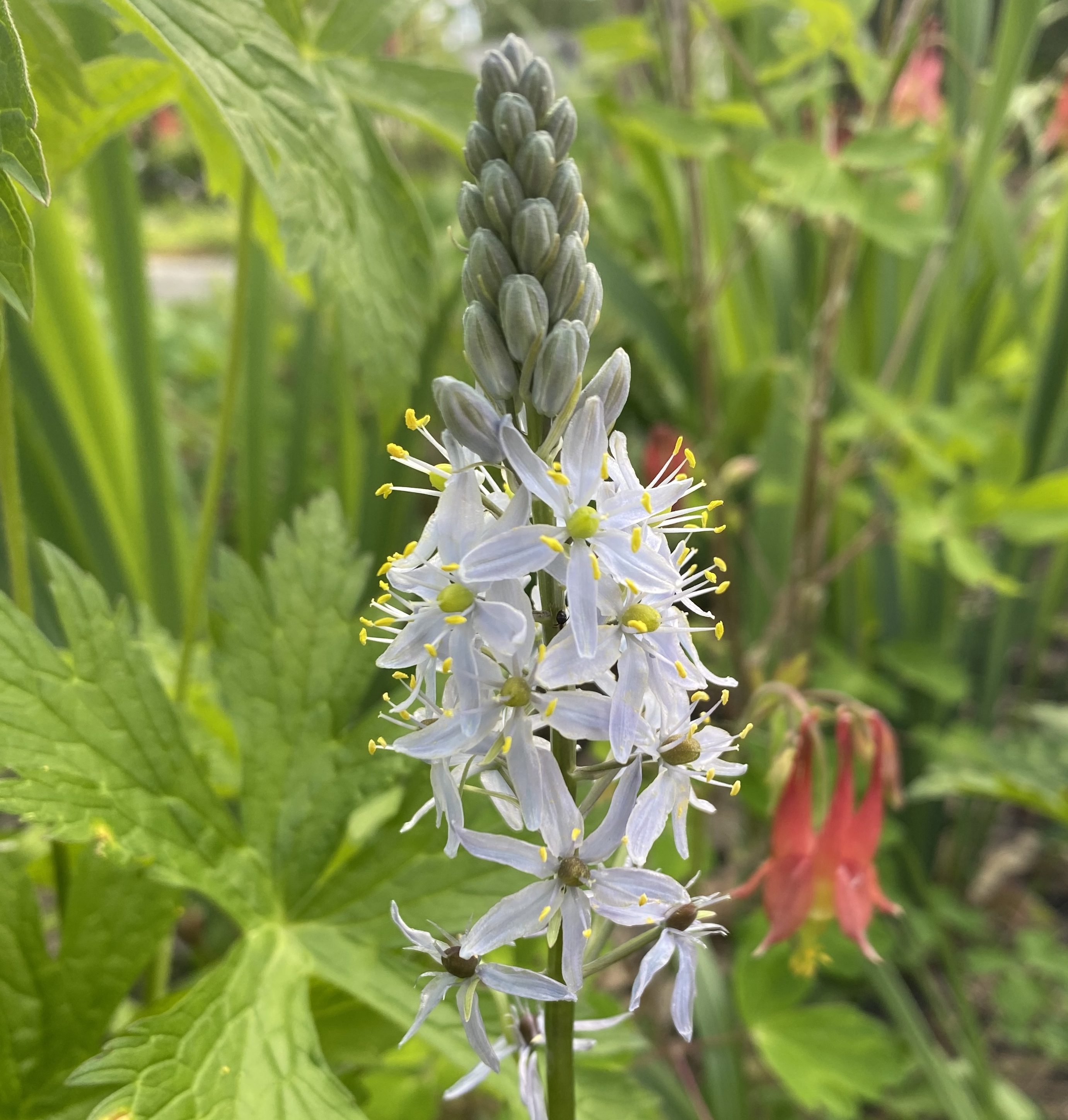
Wild hyacinth (Camassia scilloides) is not common in Wisconsin gardens and casual prairie plantings, but it should be: it’s easy to maintain, it provides early-season nectar for pollinators, and its spires of fragrant, pale-blue flowers add structure to native plantings. The bulbs are also a traditional food source, but because they look similar to the toxic mountain death-camas (Anticlea elegans), novice foragers should exercise extreme caution. Here in Wisconsin, they are endangered, so it would be unethical to forage them anyway.

Prairie Moon sells bulbs for wild hyacinth, but it is otherwise quite rare in the nursery trade, and if you want the true native species, only buy from reputable vendors like Prairie Moon. For my part, I prefer growing from seed (it’s more economical, and more fun), but be aware that it can take more than a year for seedlings to be large enough to plant out into the field, and it can take a few years for seed-grown plants to produce a flower stalk. For that reason, unless you’re an avid propagator of native plants, I’d suggest starting from bulbs. Just make sure to buy more than you think you need; an individual plant is quite small, so they look better in clusters of three or more.
Here in Dane County, Wisconsin, we’re right on the northwest edge of its range, and I hardly see it in the wild (as mentioned, it is endangered in Wisconsin). Its preferred habitats include mesic prairie and savanna. Neither dry nor wet, mesic habitats occupy the middle of the moisture continuum (mésos means “middle” in Ancient Greek). Because mesic habitats are neither drought-prone nor waterlogged, they are ideal for farming, and consequently the vast majority of mesic prairies have been converted to farmland. In Wisconsin, only about 100 acres of the original 800,000 acres of mesic prairie remain. As for mesic savannas, essentially no remnants of this ecosystem remain in Wisconsin, though a few remnant oak savannas exist on drier sites (oak savannas as a group are the rarest plant community in Wisconsin).
For comparison, dry prairie remnants, which are ill-suited for agriculture, are less rare. According to the Wisconsin Bird Conservation Initiative, there are about 1,500 acres remaining of the original 100,000 acres of Wisconsin dry prairie. That’s not much, but it’s better than 100 acres.
This is all to say that—although it’s relatively easy for me to find remnant populations of dry prairie plants like pasqueflower (Pulsatilla nuttalliana), beach wormwood (Artemisia campestris), or silky aster (Symphyotrichum sericeum)—it’s more difficult to find remnant populations of a mesic species like wild hyacinth. The good news is that, although remnant mesic prairies are exceptionally rare in Wisconsin, mesic conditions are common here, and many garden soils have moisture levels similar to mesic prairies. So plants of the mesic prairies, like wild hyacinth, often flourish in home gardens.
Germinating Wild Hyacinth Seed
Germinating wild hyacinth seed is not difficult, despite the fact that Prairie Moon gives it a “code M” on their website. This past winter I tested—albeit haphazardly—whether:
- gibberellic acid (GA3) increases germination of wild hyacinth seeds
- longer periods of cold-moist stratification were more efficacious than shorter periods of stratification
Below is a table of my results, sorted by germination percentage:

My sample sizes were low, and most of the results are not statistically significant. I also used different treatment periods for the seeds not treated with GA3, which muddles the results. The group that received cold-moist stratification but no GA3 shows a statistically significant difference from all the groups treated with GA3. The results suggest that GA3 improves germination, but I’ll need to repeat the experiment with larger samples and a more tightly-controlled experimental design.
As for the length of cold-moist stratification, so far there is no evidence that timing makes a difference, but with larger sample sizes I do expect statistically-significant differences to emerge.
Even though germination was highest with the GA3-soaked groups, that doesn’t mean exogenous gibberellic acid is the ideal way to germinate these seeds. Rather, it raises the question “why did germination without GA3 fail to surpass 42%?” I don’t have answers to that question, but I’m certainly going to do further experiments this winter.
For native seeds, a germination percentage of about 42% is not bad. You can purchase ~688 seeds for $8.50 from Prairie Moon. So at 42% germination, $8.50 buys you 289 seedlings (2.9 cents per seedling), which is perfectly acceptable for me.

Caring For Containerized Wild Hyacinth Seedlings
Germinating wild hyacinth is straightforward, but plants reportedly won’t be large enough to flower until their third or fourth growing season. I’ve only been growing my seedlings for two seasons, so I cannot confirm that timeline, but they certainly grow extremely slowly.
Wild hyacinths are spring ephemerals, meaning that they flower and set seed in the spring, and then go dormant in the summer, rather than going dormant in the fall like many other Midwestern grassland plants. Spring ephemerals exhibit a quick growth spurt in the spring when conditions are favorable (e.g., ample moisture and sunlight) and then store energy from that growth spurt in underground structures such as bulbs, corms, or thickened roots. Whereas non-ephemerals may be actively growing for six months out of the year (e.g., mid-April to mid-October), ephemerals grow for only about one to three months. Because spring ephemerals only photosynthesize for a brief period each year and send much of their energy to underground storage to survive long dormancies, it often takes seedlings many years to start flowering.
Even if growing conditions are kept constant, spring ephemerals will only grow for a couple months after germinating, and then go dormant. This is certainly the case for wild hyacinth: the vast majority of my seedlings only grew a single cotyledon before going dormant, with not a single true leaf to show for their twenty weeks in the greenhouse. In their natural environment, wild hyacinths spend about nine months of the year dormant (from mid-summer to early spring). In order to expedite their growth, I decided to test whether artificial chilling could break dormancy of containerized bulbs, thus enabling multiple spurts of growth within a single year.1
After my seedlings started to turn yellow and go dormant, I allowed their potting soil to dry until slightly damp, then wrapped them in plastic and moved them to my refrigerator. After three months, I moved them out of the fridge and into a grow chamber held at about 20°C. Over the next few weeks, most of the seedlings have broken dormancy, and some have even produced two leaves! So three months of chilling is certainly sufficient to break dormancy in most wild hyacinth bulbs (and perhaps a shorter chilling period would also work).

The main advantage of artificial chilling is that you can squeeze two growing seasons into about twelve months. If you sow your wild hyacinth seeds in November, the following November you can plant the dormant bulbs into the field with two years’ worth of growth, ready for a winter of natural chilling. When planting out into the field, just make sure to put them in an area you can keep relatively weed-free, since they’ll be too small to compete with spring weeds. And just as when planting tulip bulbs, be sure to protect the plants from marauding squirrels (personally, I use landscape staples to fix wire mesh to the surface of the soil).
Spring ephemerals tend to transplant best when dormant, so just be sure to let the foliage die back before planting. My preference is to plant out in fall or winter so that they can experience at least three months of natural chilling, then begin growing as soon as conditions are optimal. It’s also totally fine to plant dormant plants out in the summer (I’ve done this with purchased bulbs), but it’s a little less time-efficient, since the plants will experience a longer dormancy. I tend to start stratifying seeds in September/October, so with my workflow it makes the most sense to sow seeds in early winter and then plant out into the field about a year later. But experiment for yourself and let me know what works for you! ■
Have a question? If you have questions about Midwestern native plant propagation that you want answered in a future post, I’d love to hear from you! Shoot me an email at plantpropagationproject@gmail.com or leave a comment below!
Want to stay up to date on all my propagation protocols? Subscribe for free to receive new posts and support Practical Seed Ecology:
Want to support this work? Buy me a cup of coffee (or a bag of potting medium):
Buy me a cup of coffee, a whole bag of coffee, or a whole bag of PRO-MIX BX (my preferred potting medium).
Make a monthly donation
Make a yearly donation
Choose an amount
Or enter a custom amount
Thank you for supporting this project!
Your contribution is appreciated.
Your contribution is appreciated.
Notes
- I’m not the first person to apply this technique to wild hyacinth; David J. Horvath posted a protocol with a period of artificial chilling to the Native Plant Network Propagation Protocol Database ↩︎
Leave a Reply