
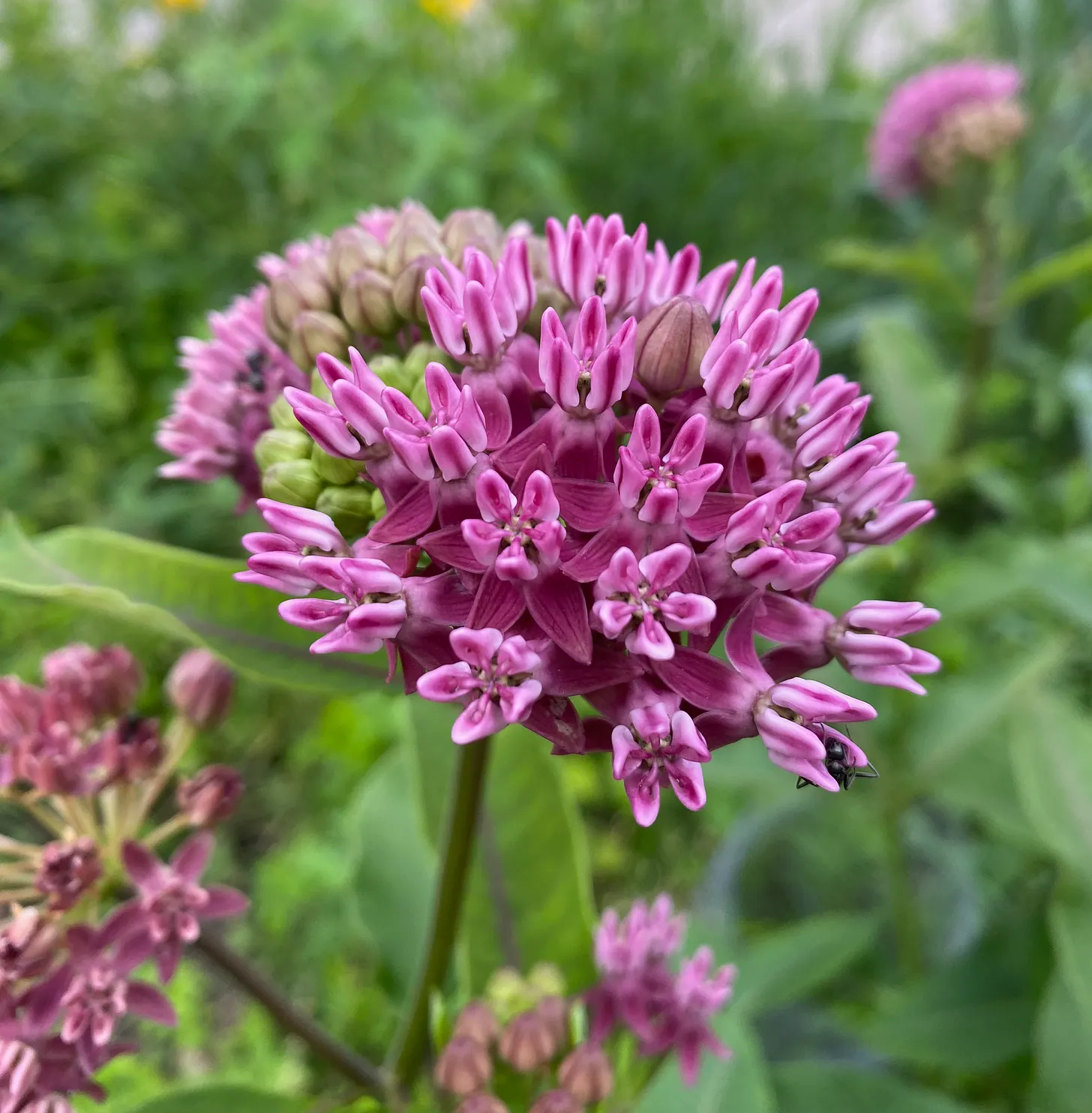
Purple milkweed (Asclepias purpurascens), endangered here in Wisconsin, looks similar to common milkweed (Asclepias syriaca), except that—compared to the lavender blossoms of common milkweed—its flowers are much more purple-ish/saturated-in-color (hence the epithet purpurascens). But unlike common milkweed, which spreads aggressively by rhizomes, purple milkweed hardly spreads at all, making it well-suited for smaller pollinator gardens where common milkweed could take over and smother neighboring plants.
I have only rarely seen purple milkweed in the wild, which can be explained by the fact that it is typically found in oak savanna, an ecosystem that has been virtually eliminated from Wisconsin. On a more hopeful note, there is at least one report of purple milkweed reappearing when degraded oak savanna was restored.1 So if you happen to have a degraded oak savanna, clearing and burning it might just bring you purple milkweeds.
In addition to being rare in the wild, purple milkweed is rare in cultivation; very few nurseries sell this plant, and those that do only sell limited quantities. Seed is also challenging to buy, and as of this writing, no reputable native seed seller that I know of has the seed in stock.2 Since plants are often slightly easier to come by (Prairie Moon tends to offer them, briefly, every year), if you want to grow this plant from seed, it might be easiest to first establish a small population from purchased live plants, and then collect seed from those plants.
In his 2009 article “Ecology and Conservation of Purple Milkweed” (available to read online with a free JSTOR account), Thomas Brock reports extensively on his work growing purple milkweed from seed, but I feel the need to contribute my own experiences to the discussion of growing this plant, since I’ve had very different results than Brock. Brock, for instance, reports extremely high germination percentages for purple milkweed: 50 out of 50 seeds germinated for one lot collected in 2005, and 46 out of 50 germinated for another lot collected in 2007. But while he saw germination as high as 100%, I never saw germination higher than 9% in my own trials. And while he generally saw good survival when transplanting into the field, I’ve had mixed results: one year I saw 100% survival in my transplants (with five out of six blooming their first year), but this year most of my transplants have died (and none have flowered).
So assuming that you’ve gotten your hands on the much-coveted purple milkweed seed, you’re probably feeling the pressure to not mess up growing these plants, and I’m hoping the information below is helpful. Like many of my posts, this is a work in progress, and I’ll update this post as new results come in.
My experience germinating purple milkweed seeds
I collected my purple milkweed seeds on October 11, 2025, then stored them dry, at room temperature, until January 15, 2026. I then divided the seeds into two groups, each consisting of 45 seeds, and subjected one group to 6 weeks of cold-moist stratification and another group to 12 weeks of cold-moist stratification. After pretreatment, I sowed the seeds into ProMix-filled pots, lightly covered with vermiculite, and germinated the seeds at simulated spring temperatures (20°C days, 10°C nights). For more information on the temperature regimes I use, see my article on that topic.
In both groups, germination could be observed as early as day 5, and total germination was assessed at day 14. All seeds that germinated developed quickly into robust seedlings (see figure 1).

I observed the seeds until day 28, but no additional germination occurred after day 14. The group stratified for 6 weeks had 1 seed germinate, and the group stratified for 12 weeks had 4 seeds germinate (see table 1). The difference in germination between the two groups was not statistically significant, meaning that we cannot rule out that the difference observed was due to random chance. Notably, my germination percentages are much, much lower than Brock’s. It’s possible that this could be due to minor differences in methodology (e.g., his seeds were fully exposed to light, whereas mine were dusted with vermiculite), but my hunch is that my seeds had lower viability than his. Perhaps in future years I’ll systematically test viability, but based on vibes alone, I can say that the seeds I collected lacked the plumpness that I like to see in Asclepias seeds.

It’s also worth noting that I didn’t test germination for seeds that were not stratified at all, despite the fact that many milkweeds do not require or benefit from stratification, and in future years I’ll test an unstratified control.
So, provisionally, my advice is to stratify for about three months, but I’ll update that advice when I achieve better germination.
Growing purple milkweed seedlings in containers
Some milkweeds, such as whorled milkweed (Asclepias verticillata), languish when seedlings are grown at simulated spring temperatures (20°C days, 10°C nights), and I therefore grow most of my milkweeds at simulated summer temperatures (30°C days, 15°C nights). Purple milkweed, however, seemed perfectly happy to grow at simulated spring temperatures, which makes sense given that it grows in soils kept cooler by dappled savanna shade.
The main thing to know about growing purple milkweed in containers is that it grows really fast. In my experience, purple milkweed seedlings fill out 1-quart pots in about 7 weeks (see figure 2), and they fill 2.5-in.×2.5-in.×3.5-in. pots even quicker. My impression (unsubstantiated by any rigorous testing) is that they don’t like being transplanted too early in the season, so I recommend sowing them in late April or early May so that they’re ready to plant out into warmer spring conditions in mid-June.

As with all my containerized seedlings, I fertilize regularly. Brock notes that, in the absence of fertilizer, seedlings become chlorotic,3 so fertilization may be essential to seedling survival.
Planting out purple milkweed seedlings
My experience of planting purple milkweeds out is that they are prone to spontaneously dying, and I have no idea why. I planted some out in early May, and those quickly senesced (see figure 3). I initially assumed they were sad about colder conditions or shorter day lengths, but I’m no longer confident in that. I planted more seedlings in mid-June, when days were long and weather was warm, and many of those died too. The specimens that survived were also more shaded by surrounding shrubs, so it’s possible that purple milkweed needs at least some shade to survive transplanting. With that being said, last year I transplanted all my purple milkweeds into full sun, and 100% survived, though they did get shaded a fair amount by aggressive pokeweed (Phytolacca americana) later in the season.

Next year I’m planning to run field trials testing whether various levels of shade (achieved using shade cloth) affect seedling survival. Stay tuned for that.
A note about purple milkweed morphology
Purple milkweed specimens, even those belonging to the same population, can take on a wide variety of vegetative forms (see figure 4). It is therefore very difficult to identify a purple milkweed without seeing its flower (or seed pod).


In his article about purple milkweed, Brock emphasizes this point, writing:
If the plant is not flowering, it cannot be positively identified as purple milkweed. Although field guides often confidently describe vegetative characteristics, most of these are variable and uncertain. Frequently they are based on the characteristics of a few herbarium specimens. According to Farnsworth and DiGregorio (2001), misidentification in the field has led to incorrect labels on at least one voucher specimen at the Gray Herbarium at Harvard University.4
So don’t try to identify your purple milkweeds based on vegetative characteristics alone! ■
Have a question? If you have questions about Midwestern native plant propagation that you want answered in a future post, I’d love to hear from you! Shoot me an email at plantpropagationproject@gmail.com or leave a comment below!
Want to stay up to date on all my propagation protocols? Subscribe for free to receive new posts and support Practical Seed Ecology:
Want to support this work? Buy me a cup of coffee (or a bag of potting medium):
Buy me a cup of coffee, a whole bag of coffee, or a whole bag of PRO-MIX BX (my preferred potting medium).
Make a monthly donation
Make a yearly donation
Choose an amount
Or enter a custom amount
Thank you for supporting this project!
Your contribution is appreciated.
Your contribution is appreciated.
Notes
- T. D. Brock, “Ecology and Conservation of Purple Milkweed,” Ecological Restoration 27, no. 3 (2009): 269–77, https://doi.org/10.3368/er.27.3.269. ↩︎
- As of July 2026, seed is sold out at Prairie Moon Nursery, and not offered by Prairie Nursery, Agrecol, Shooting Star Native Seed, Wildtype, Ion Exchange, Allendan Seed Company, Missouri Wildflowers Nursery, Spence Restoration Nursery, Roundstone Native Seed, Michigan Wildflower Farm, and Ernst Seeds. If you know of a reputable vendor of purple milkweed seed, please let me know in the comments. ↩︎
- Brock, “Ecology and Conservation,” 274. ↩︎
- Same as above, 270–271. ↩︎

Leave a Reply