
Passiflora incarnata
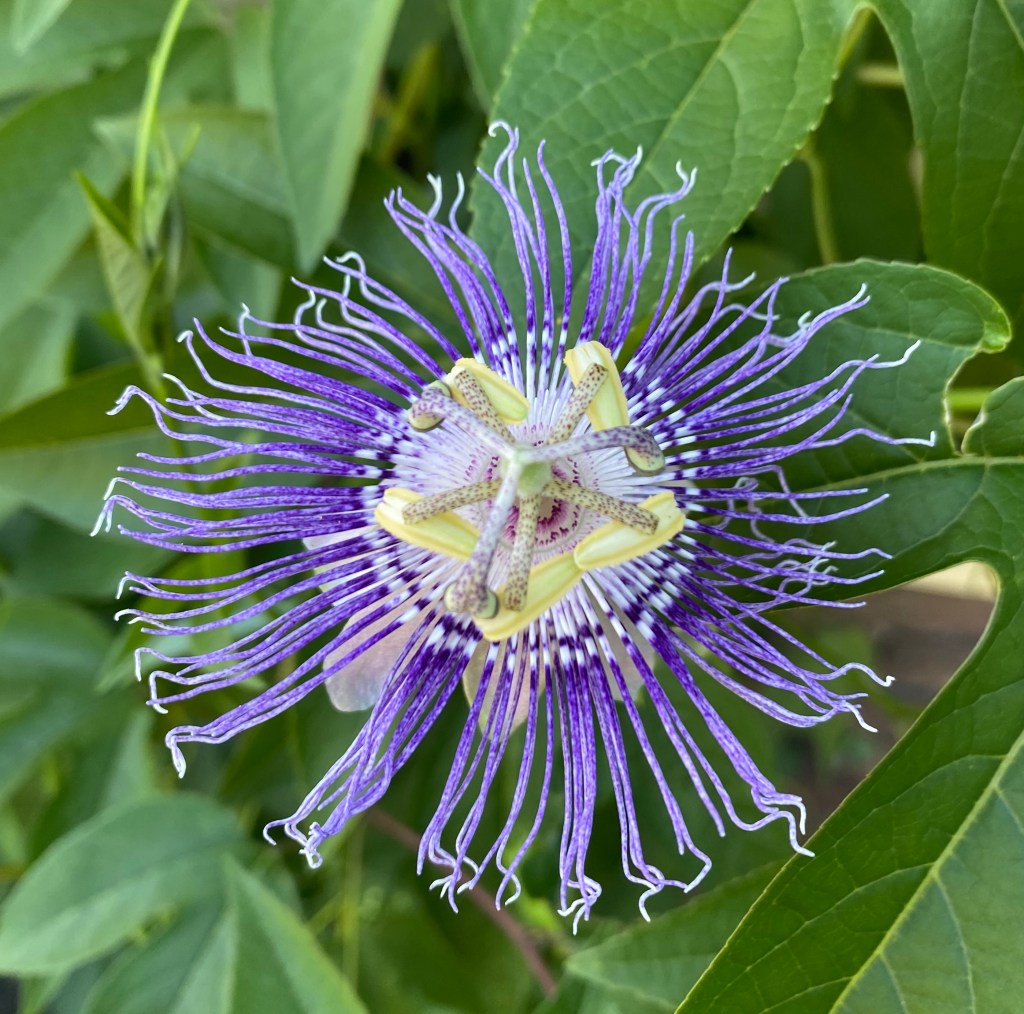
Quick facts
Common Names
Family
Dormancy Type
pretreatment protocol
Sowing temperature regime
Light requirement for germination
Days to first germination
Weeks to fill Nursery Pot
How to Grow Passiflora incarnata (Maypop, Purple Passionflower) from Seed
I typically write about propagating plants native to southern Wisconsin, but today I’m making an exception to write about Passiflora incarnata (maypop, purple passionflower), which is native to the Southeastern United States. My motivation is twofold:
- This plant is used extensively by herbalists, so I anticipate that many people are eager to grow it from seed. Although it is native to the United States, most bulk herb available is imported from France or Italy (and most of the scientific articles on its propagation come out of Italy). Interesting.
- The internet is awash with misinformation, and unfortunately that extends to germination protocols. Information on germinating P. incarnata is particularly inaccurate. While it’s been long-known in the scientific community that P. incarnata seeds do not require pretreatment, that has not permeated the first 50 Google results for “germinating Passiflora incarnata.” I doubt this post will ever make it close to the top of Google’s search results, but I still feel it necessary to do my part to fight for the truth.
Contrary to what you may have read online, germinating Passiflora incarnata seeds is not difficult, nor does it take a long time. In fact, starting P. incarnata from seed is just like starting squashes or melons: bury the seeds and give them heat. Within ten days, 70–90% of seeds will germinate. It’s that easy.
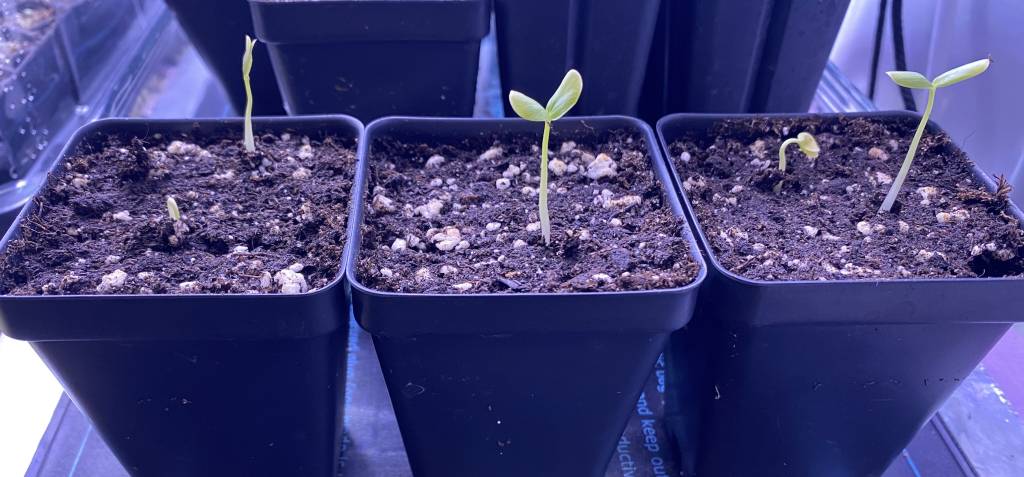
Maybe you’ve read that P. incarnata seeds need pretreatment to reliably germinate. In fact, two of my favorite seed companies—Prairie Moon and Truelove—suggest pretreating the seeds. Look, these are companies that I respect a lot, but not everyone is right about everything.
Despite what you may have read, P. incarnata seeds are non-dormant; they do not require any type of pretreatment to germinate. They do not need to be scarified (e.g., nicked with a blade, rubbed with sandpaper) because they have no physical dormancy. And they do not need to be stratified because they have no physiological or morphological dormancy.
Passiflora incarnata seeds require heat to germinate, and benefit from darkness
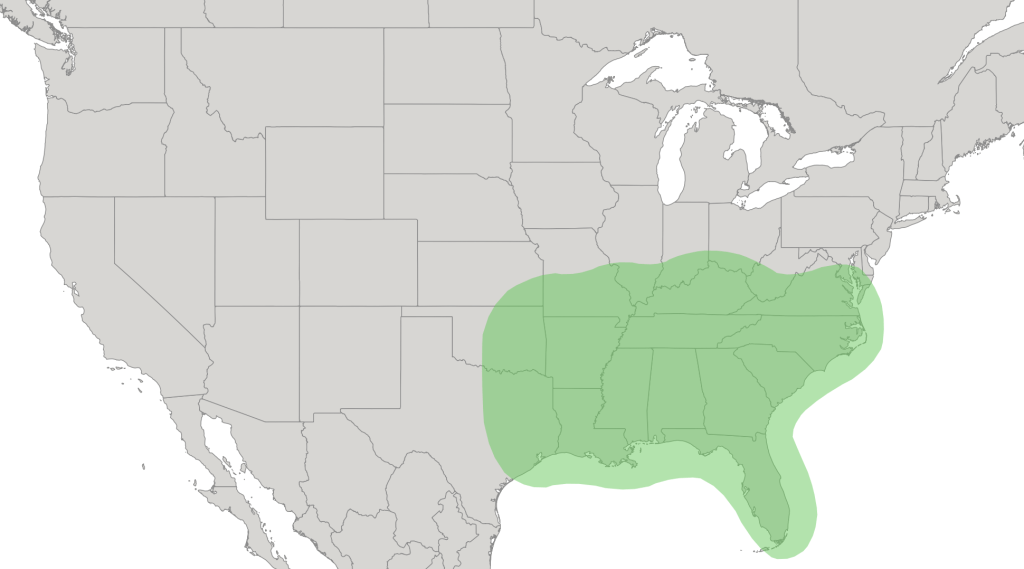
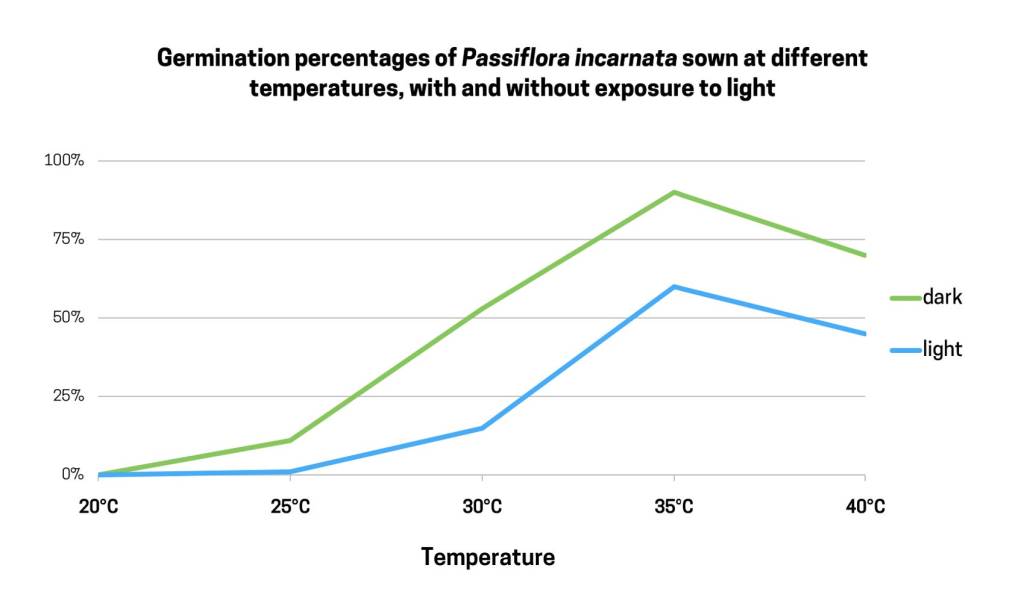
P. incarnata germinates best at about 35°C/95°F. These seeds love the heat, which makes sense, because they are native to the southeastern United States (see Figure 2), and they germinate during the summer. If you’ve tried and failed to grow P. incarnata from seed, you probably didn’t have the seeds hot enough. Benvenuti, Simonelli, and Macchia tested P. incarnata germination at various temperatures, and they found that 30°C/86°F was required to see germination over 50%, with 35°C/95°F producing the best results (see Figure 3).1
Exposure to light inhibits P. incarnata germination. In the scientific literature, seeds that germinate best in darkness are sometimes described as negatively photoblastic. Although P. incarnata will still germinate when exposed to light, germination will be lower. When testing P. incarnata at 35°C, Benvenuti, Simonelli, and Macchia reported 90% germination for seeds incubated in darkness, and 60% for those incubated with light.2 Under natural conditions, seeds experience darkness when they are buried relatively deeply (½ inch or so). While I can only speculate as to why they’ve developed this adaptation, perhaps P. incarnata prefer germinating when buried deeply because, during the hot summers when it sprouts, more moisture is retained deeper in the ground, so deeper burial could lead to greater seedling survival. At any rate, don’t surface-sow these seeds; give them a nice ½ inch of potting medium.
Once the seeds germinate, they need a fair amount of warmth to grow. My grow chamber was set to an alternating temperature regime of 20/10°C (read more about temperature regimes here), and the P. incarnata seedlings did not like those cold 10°C nights. So I moved them into my apartment, where the temperature fluctuates from 17°C to 24°C, and they grew at a rapid clip.
My P. incarnata seedlings exhibited an extremely high level of sensitivity to their roots being crowded. When I grow seedlings, I typically transplant them when the roots have formed a tight mass that holds the soil together. But P. incarnata seems to stop growing as soon as the roots run out of space, and the roots seem reluctant to grow tightly enough to hold the soil together. When growing them in 2.5” pots, this meant they stopped growing after forming just a few true leaves (total height of 6”). But as soon as I potted up to quart-sized containers, they grew quickly again, reaching 18″ in just a few weeks (see Figure 4).
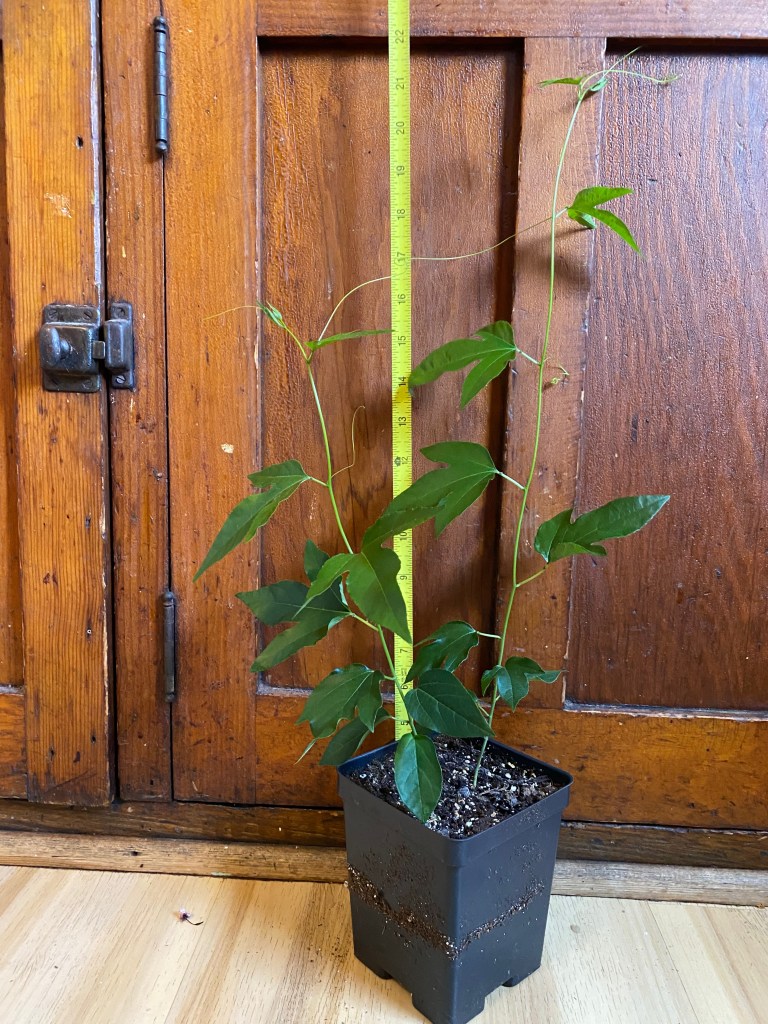
Even more interestingly, when grown two-per-pot in 2.5” pots, the first seedling to germinate would grow quickly, but the second to germinate would stop growing, entering a sort of stasis with just a single small true leaf. But as soon as I potted up to quart-sized containers, the smaller seedling would rapidly grow. My hypothesis is that the presence of a larger seedling inhibits the growth of the smaller seedling. Members of the Passiflora genus are known to produce allelopathic chemicals3 (natural herbicides to prevent competition), so is it possible that P. incarnata is sensitive to its own allelopathic root exudates? That’s a topic for another day, but the practical takeaway is that larger pots are better. ■
Have a question? If you have questions about Midwestern native plant propagation that you want answered in a future post, I’d love to hear from you! Shoot me an email at plantpropagationproject@gmail.com
Want to support this work? Buy me a cup of coffee (or a bag of potting medium) with the donation button at the bottom of this page. Or better yet, send me your germination success stories.
Notes
- S Benvenuti, G Simonelli, and M Macchia, “Elevated Temperature and Darkness Improve Germination in Passiflora incarnata L. Seed,” Seed Science and Technology 29, no. 3 (2001): 533–41, https://www.cabidigitallibrary.org/doi/full/10.5555/20013151186. ↩︎
- Same as above. ↩︎
- See, for instance: T. D. Khanh, I. M. Chung, S. Tawata, and T. D. Xuan, “Weed Suppression by Passiflora edulis and Its Potential Allelochemicals,” Weed Research 46 (2006): 296–303, https://doi.org/10.1111/j.1365-3180.2006.00512.x. ↩︎
Buy me a cup of coffee, a whole bag of coffee, or a whole bag of PRO-MIX BX (my preferred potting medium).
Make a monthly donation
Make a yearly donation
Choose an amount
Or enter a custom amount
Thank you for supporting this project!
Your contribution is appreciated.
Your contribution is appreciated.
 Practical Seed Ecology