
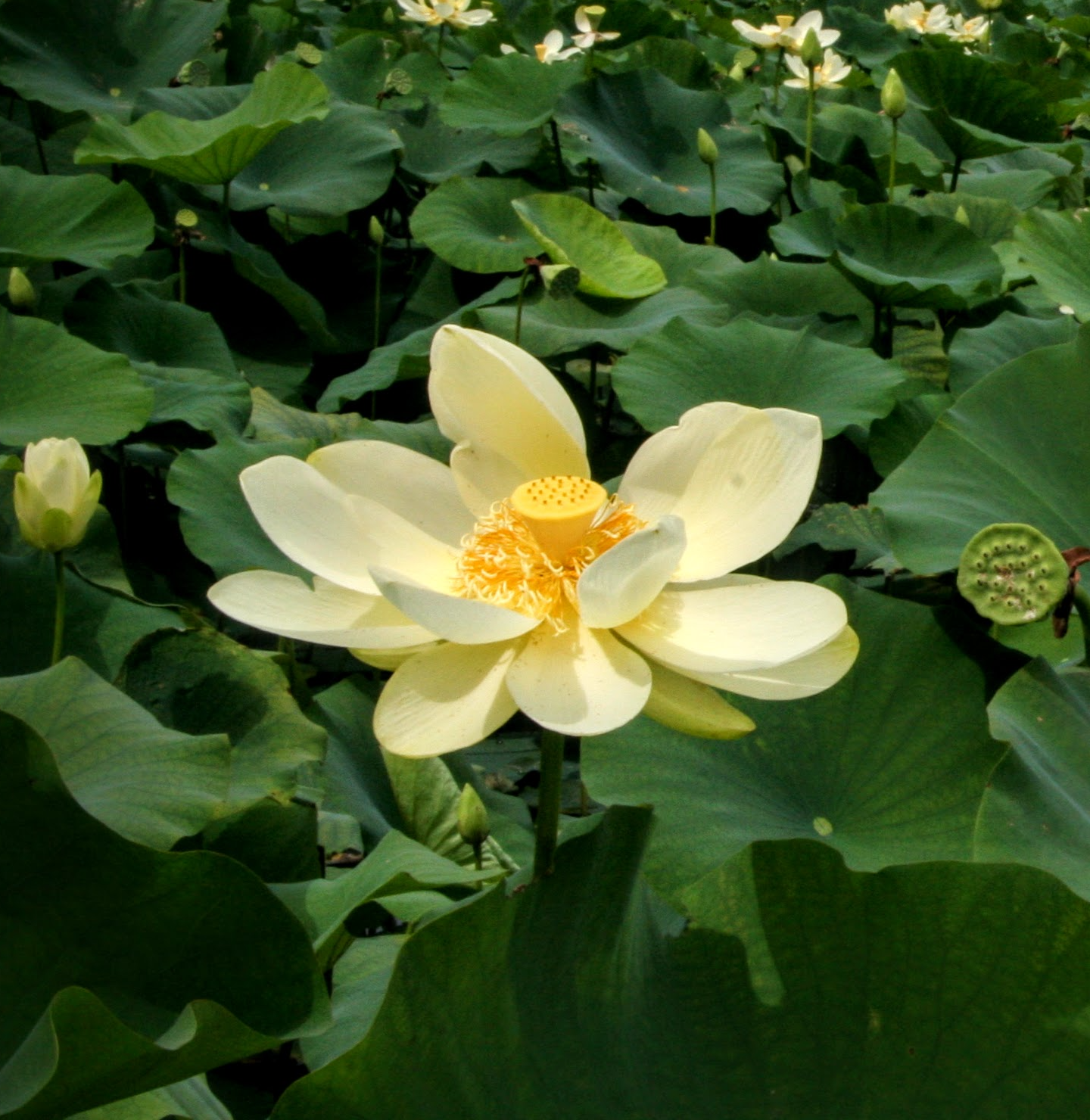
The Practical Seed Ecology email inbox has been flooded with complaints that I unfairly focus on upland species, so today I appease my readership by presenting my progress on developing a propagation protocol for an aquatic plant: the American lotus (Nelumbo lutea). The American lotus is relatively secure here in Wisconsin (and if you’re in Madison, there’s an excellent lotus patch at Warner Park), but in many states it’s listed as endangered, threatened, or a species of concern. Like many wetland plants, it is threatened by the fact that its habitat—shallow, still waters—is being destroyed. In urban areas, wetlands have been filled to create usable land for development; in agricultural areas they are often drained to create additional productive land; and in inland waterways, dredging has degraded wetland habitat.


Even though the American lotus is threatened in many parts of its range, it is not a meek plant. If you plant them in your pond, you may soon find every square inch of your pond filled with lotus (see Figure 1 above). If that idea excites you, then proceed without caution. If it makes you nervous, make sure to plant them in lily/lotus tubs so that their rhizomes are contained.
Seed collection
A few months ago, a Practical Seed Ecology reader gifted me with a packet of lotus seeds from Prairie Moon Nursery, and I’ve been working to grow them out since then. If you’re reading this in September, now would be a good time to gather your own lotus seeds. Because they grow in shallow mucky ponds, my method of collecting seeds is to hike up my shorts and wade through the muck. If you have waders, this would be a good use for them. And it’s also possible you could gather them from a kayak or canoe.

Seed pretreatment
I used Jeff Sayre’s germination protocol as inspiration,1 but I didn’t follow it to a tee (though I probably should have). Below is a description of what I did, but I’m not suggesting you proceed exactly as I did, since mistakes were made. I’ve tried to clarify which actions were in line with the Sayre protocol, and which deviated.
1. Identify viable seeds
Sayre’s guidance:
Retain the seeds that sink and discard the seeds that float; floating seeds have poorly developed or rotten embryos.2
I did exactly as Sayre recommended. Out of about 110 seeds, only a handful floated, and of those floaters, all but one were obvious immature seeds. So this step wasn’t particularly useful.

2. Scarify viable seeds
American lotus seeds have water-impermeable seed coats, the technical term for which is physical dormancy. Seeds with physical dormancy cannot imbibe water, and therefore will not germinate. To break physical dormancy, we must use some method of scarification to weaken or alter the seed coat. There are numerous methods of scarification, but for lotus seeds, mechanical scarification is most common.
Per Sayre’s protocol:
The simplest approach is to scratch off a small area of seed coat using medium grade sandpaper.3
I scarified my seeds by rubbing with 150-grit sandpaper. When sanding seeds, avoid sanding the white endosperm within, as this may diminish viability. Lotus seeds coats are very thick, and it takes a lot of effort to sand all the way to the endosperm, so you probably won’t accidentally sand the endosperm. I try to remove about a millimeter of the seed coat, but it’s not an exact science.

Germination
When it comes to actually germinating the lotus seeds, Sayre’s only guidance is:
It is important to change the water daily as you wait for seeds to germinate.4
In the absence of any information on germination temperature, I let the scarified seeds sit on my kitchen counter in water (reverse osmosis–filtered) until germination, changing the water every few days (despite Sayre’s advice to change daily). After two weeks, seeds had germinated.

I’m usually a stickler for precise germination temperature, and I’m currently conducting experiments to assess the ideal temperature for American lotus seeds—stay tuned! The only information on germination temperature I’ve found is from David Francko’s work, who used an alternating temperature regime of twenty-four hours at 35°C followed by twenty-four hours at 23°C.5 I’m not a fan of this type of schedule, since it doesn’t approximate any cycle seeds would experience in situ. But Francko’s results make me suspect that alternating day/night temperatures of 35/25°C (or 30/20°C) could be effective. For more info on alternating temperature regimes, read this article.
Seedling care
Sayre’s guidance here is a bit tricky to parse:
Once seeds have germinated and the root begins to emerge (but before the leaves are up), transplant them to a 10-cm (4-in) pot filled with a loamy-clay. We place pots in 2.5 to 5 cm (1 to 2 in) of warm water in holding ponds.6
I’m not exactly sure what Sayre means by “leaves are up,” but in my experience, leaves emerge before roots, so I chose to plant out seeds shortly after leaf emergence. Although I use soilless potting media for all my upland plants, for aquatic plants, it’s very important that you use actual mineral soil. Peat, coir, and perlite will all float on top of water, and for growing aquatic plants, we need something that sinks in water. I dug soil from my yard to use as the planting medium (my soil is loam, not Sayre’s suggested clay loam). If the difference between loam and clay loam means nothing to you, check out the USDA soil texture triangle below. Although I chose to use loam, and Sayre used clay loam, I’m not sure if the soil texture truly makes a difference. In my current trials I’m testing whether sand makes a suitable substrate.


Although Sayre suggests filling pots with substrate, and putting those pots in a holding pond, I did not have a holding pond, so I didn’t do things that way. I chose to use a mason jar instead, putting soil directly in the mason jar, and putting the seeds on top of that soil. This was a big mistake! Lotus seedlings need to be grown out in a wide vessel (ideally eighteen inches or wider). Even though there were only a few inches of water in the mason jars, the stems of the lotus leaves grew insanely long, surpassing five feet in length. My hypothesis is that some sort of signaling takes place when a leaf reaches the water’s surface, telling the stem to stop growing. But when the stem is in contact with the sides of the mason jar, this signaling gets confused or disrupted. After perusing some forums devoted to cultivating ornamental lotuses, I learned they sell special pots (with no holes) that are about twenty inches in diameter and ten inches tall for this purpose. And you can also repurpose a livestock feeding pan for this (though the rubber one I bought has a very intense smell).

It’s now been nearly four months, and the seedlings have developed nicely, though they’re a bit smaller than I expected. Sayre mentions growing them in “warm” water, and it’s possible my water is not warm enough. For future experiments, I’ll try heating the water with a fish tank heater. Sayre also notes that the fertility of the soil used is typically sufficient for the first year of growth, but I nevertheless fertilized a bit with liquid fertilizer. Adding liquid fertilizer does cause a lot of algae to grow, so I’m not sure I recommend it, and given the somewhat weak performance of my plants, I’m not sure it helped. ■

Have a question? If you have questions about Midwestern native plant propagation that you want answered in a future post, I’d love to hear from you! Shoot me an email at plantpropagationproject@gmail.com or leave a comment below!
Want to stay up to date on all my propagation protocols? Subscribe for free to receive new posts and support Practical Seed Ecology:
Want to support this work? Buy me a cup of coffee (or a bag of potting medium):
Buy me a cup of coffee, a whole bag of coffee, or a whole bag of PRO-MIX BX (my preferred potting medium).
Make a monthly donation
Make a yearly donation
Choose an amount
Or enter a custom amount
Thank you for supporting this project!
Your contribution is appreciated.
Your contribution is appreciated.
Notes
- Jeff Sayre, “Propagation Protocol for American Lotus Nelumbo lutea Willd.,” Native Plants Journal 5, no. 1 (2004): 14–17, https://doi.org/10.2979/NPJ.2004.5.1.14. ↩︎
- Same as above, page 16. ↩︎
- Same as above, page 16. ↩︎
- Same as above, page 16. ↩︎
- David A. Francko, “Studies on Nelumbo lutea (Willd.) Pers. I. Techniques for Axenic Liquid Seed Culture,” Aquatic Botany 26 (1986): 113–17, https://doi.org/10.1016/0304-3770(86)90009-4. ↩︎
- Sayre, “Propagation Protocol for American Lotus,” 16. ↩︎
Leave a Reply