
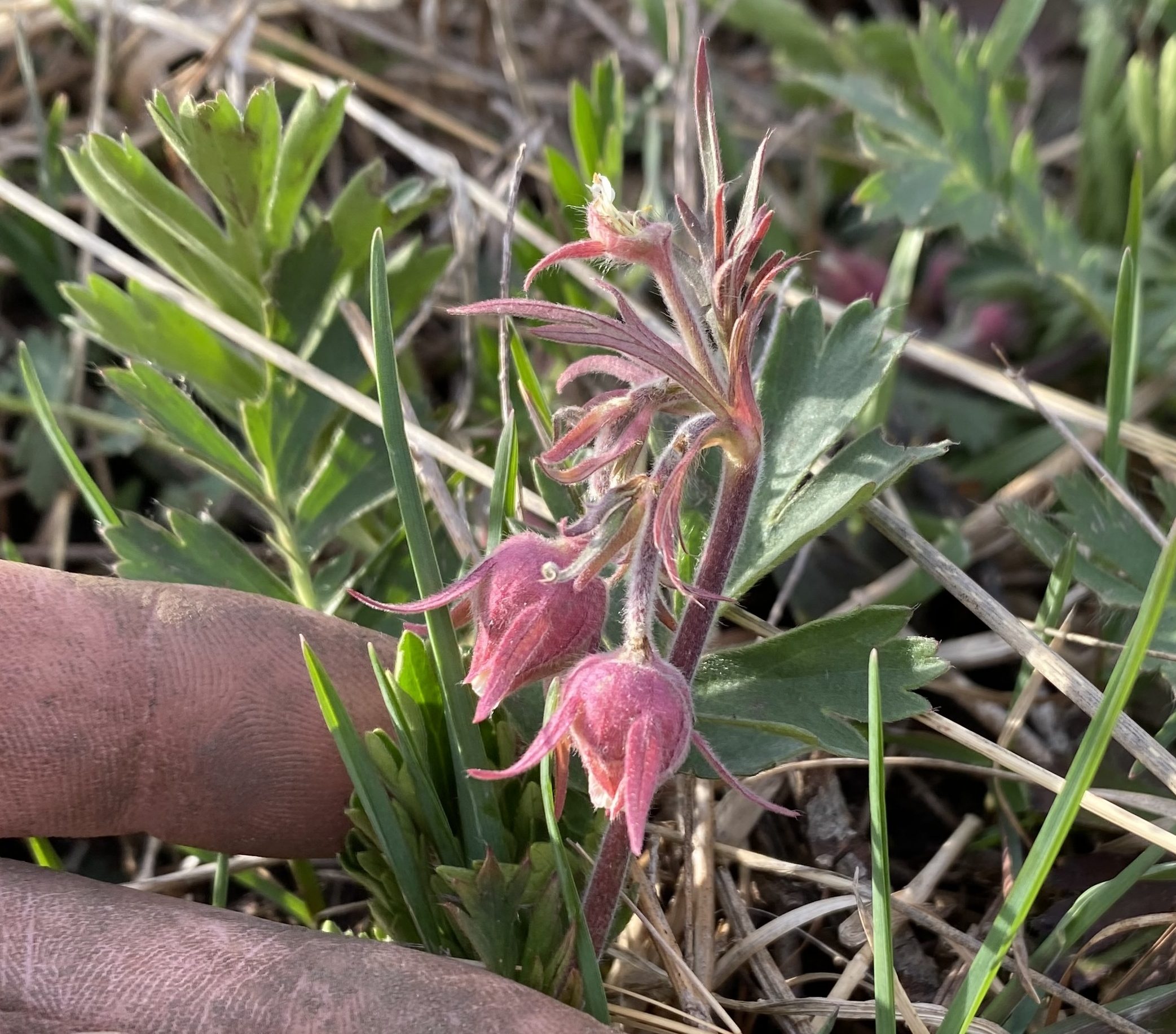
Prairie smoke (Geum triflorum) is one of the earliest prairie flowers to bloom here in Wisconsin, where it begins putting on its show shortly after American pasqueflower (Pulsatilla nuttalliana). In the early spring, when the winds are cold and most of the prairie is still asleep, its demure, rose-colored flowers are quite thrilling. The blooms are quickly followed by a display of silky styles, to which it owes its common names “prairie smoke” and “old man’s whiskers.”

Prairie smoke is not particularly rare in cultivation, but it is threatened in New York and Michigan, on the southeastern edge of its native range. Prairie Moon lists this as a code M seed (“best planted outdoors in fall”), which perhaps has scared off a few native plant enthusiasts who prefer indoor container culture. Followers of this blog may know that I’m on a mission to propagate—indoors—each and every species that Prairie Moon lists as code M. So does prairie smoke deserve Prairie Moon’s code M scarlet letter? No, the code M is not deserved; this plant can easily be started indoors and it transplants well, so don’t feel compelled to follow Prairie Moon’s advice.
In past years, I’ve noticed that Geum triflorum seedlings available locally are extremely small, which led me to believe that this is a very slow-growing seedling. So I decided to stratify my seeds mid-October, and I began sowing mid-November. This turned out to be much too early; it grew at a medium pace, taking 15 weeks to fill out 5” deep plugs (see image below).

Because I falsely interpreted Prairie Moon’s code M to mean that this was a difficult seed to germinate, prior to four weeks of cold stratification, I soaked a portion of my seeds for 24 hours in 250ppm and 500ppm solutions of gibberellic acid (GA3) to see if that would promote germination. The answer is no, GA3 does not improve germination. The control group had a 55% germination rate, while the GA3 groups had germination rates of 42% to 50%. I ran a Pearson’s chi-squared test to assess statistical significance, which yielded a p-value of 0.68, meaning that there was no statistical significance in the germination rates between the two groups (each treatment group was about 25 seeds).
I also was curious if temperature would have a significant effect on germination, so I tested two temperature regimes: 20/10°C and 15/6°C. After 14 days, the warmer group had a 55% germination percentage and the cooler group had a 40% germination percentage, but the difference was not statistically significant, with the chi-squared test yielding a p-value of 0.53. I promise I’ll use a bigger sample sizes next time so that I can report some significant results!
While the difference in overall germination was not statistically significant, there was a significant difference in the speed of germination for the two groups, with seeds germinating faster in the warmer group (p=0.002). I didn’t perform enough replicates to use the typical statistical test for speed of germination, so I did some sloppy stats, taking the t-statistic for the distributions of time-to-germination for each viable seed. This is a bit of an abuse of statistics, so take my results with a grain of salt.

My experiments are not yet complete. I have more seeds in the fridge so that I can test germination after 8 and 12 weeks stratification, so keep an eye out for future posts on those results. But 55% germination isn’t bad for native perennials, and it’s certainly good enough for home growers. So 4 weeks cold stratification, then sowing at a 20/10°C temperature regime seems to be a reliable means of propagating prairie smoke. ■
Have a question? If you have questions about Midwestern native plant propagation that you want answered in a future post, I’d love to hear from you! Shoot me an email at plantpropagationproject@gmail.com or leave a comment below!
Want to stay up to date on all my propagation protocols? Subscribe for free to receive new posts and support Practical Seed Ecology:
Want to support this work? Buy me a cup of coffee (or a bag of potting medium):
Buy me a cup of coffee, a whole bag of coffee, or a whole bag of PRO-MIX BX (my preferred potting medium).
Make a monthly donation
Make a yearly donation
Choose an amount
Or enter a custom amount
Thank you for supporting this project!
Your contribution is appreciated.
Your contribution is appreciated.
Leave a Reply