
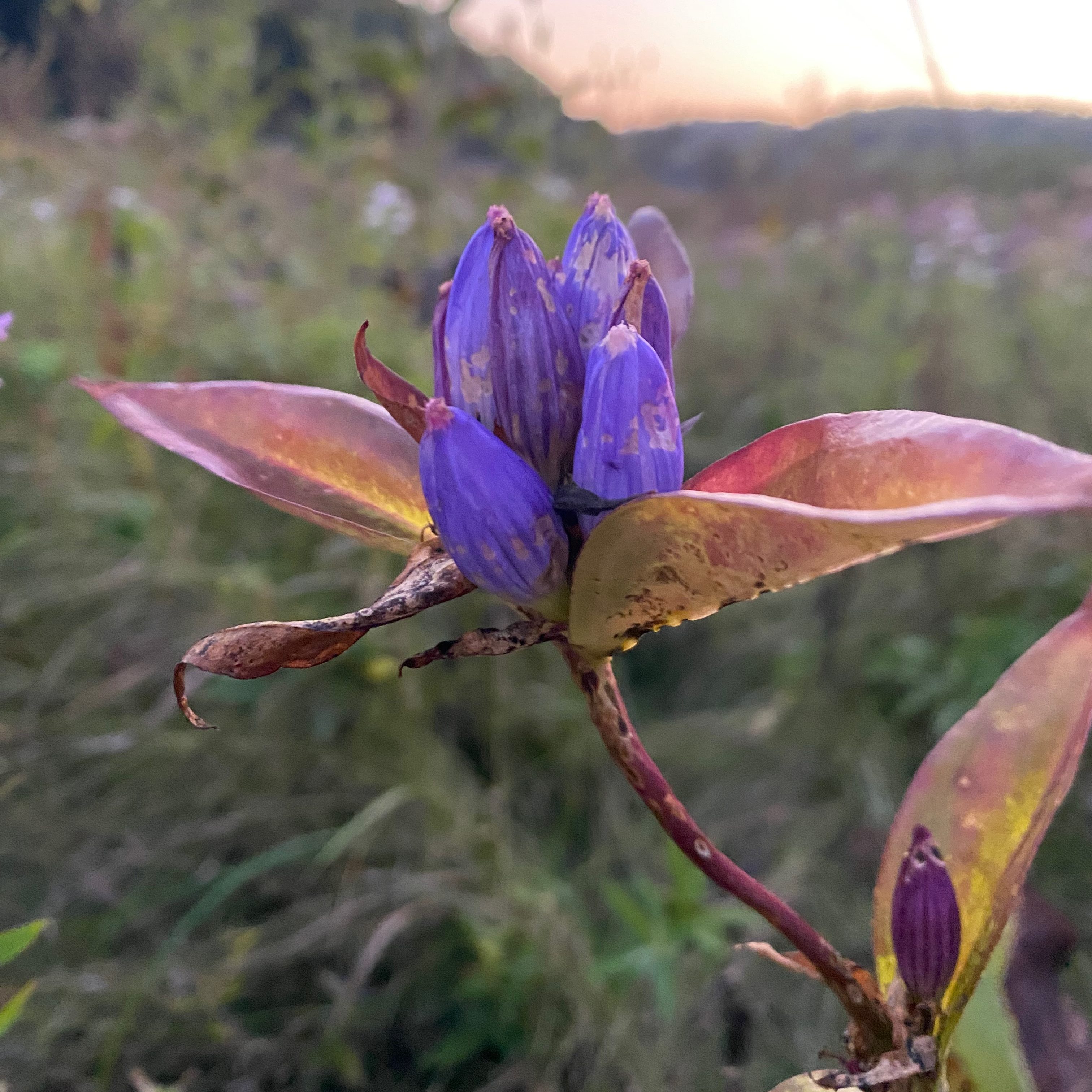
Bottle gentian (Gentiana andrewsii) is somewhat unique in that its flowers never open. Whereas many flowers advertise a frictionless feeding experience to a wide variety of pollinators—offering easy nectar, enticing scents, and an accessible landing pad—bottle gentians take a much more targeted approach to marketing. But bees that are in the know know bottle gentian, and they’re willing to spend a little extra energy to feast on their polleny delights (see figure 1). Maybe the aura of exclusivity drives up demand among bumblebees—I don’t know, I’m not a bee ecologist. But at any rate, watching bumblebees prise open these blooms as they enter and exit is always a delightfully whimsical pastime, especially considering that these flowers are in bloom in early October when much of the prairie has long since set seed and gone to bed.

Bottle gentian will tolerate a range of soil conditions, but in the wild it favors wet-mesic and wet prairies, and I find it growing near other charismatic moisture-loving forbs like turtlehead (Chelone glabra), swamp lousewort (Pedicularis lanceolata), Ohio spiderwort (Tradescantia ohiensis), and New England aster (Symphyotrichum novae-angliae).
Although I have seen it for sale at some native plant nurseries, it is somewhat uncommon in cultivation, and often expensive. Last time I checked, Prairie Moon was selling bare root plants for $20.00 each. I have found plants in quart pots for $8.00 at a local nursery, but they flowered a different shade of blue than I’m accustomed to, so I suspect the genetics were different from the local genotype, and it may been a nativar. So if you want a lot of these plants, and you want them cheaply, you’ll need to grow them from seed.
I’ve spent years trying and failing to germinate bottle gentian, so I’m really excited to post this propagation protocol. I’ve written frequently about how Prairie Moon’s propagation protocols are often wrong, and today I’d like to add some nuance to that. Prairie Moon’s germination protocols capture, broadly, some of the most important dimensions of seed propagation: cold stratification, warm stratification, and scarification, to name a few. But Prairie Moon fails to capture some dimensions that are critical to germination success. These dimensions include germination temperature (which I’ve written about previously), and seed freshness (which I’ll discuss below). So sometimes the information that Prairie Moon provides is all correct, but some additional critical piece of information is missing. This is the case for bottle gentian.
We often take it for granted that seeds can be dried, stored, and then planted. After all, this is the essence of modern agriculture. But out in the wild, it doesn’t usually work like that. There is no team of muskrats harvesting gentian seeds, putting them in paper envelopes, storing them dry for the winter, and then sowing them in the spring. Rather, the seeds fall onto moist soil soon after ripening, and sit there until they germinate.
Seeds that can be dried, stored, and then germinated are known as “orthodox” in academic parlance, and most seeds are orthodox. Many of these seeds not only tolerate drying, but also require it. But some seeds are “recalcitrant” (also called “desiccation-sensitive”), and are very difficult or impossible to germinate once they’ve dried out. This trait has been well-described in studies on rainforest trees, as well as some temperate trees. And there are certainly many herbaceous plant seeds that are known to be desiccation-sensitive, even if that fact has never been reported in the academic literature.
My hypothesis is that bottle gentian seeds are desiccation-sensitive. If you’ve tried and failed to germinate this plant, the problem is almost certainly that your seed was too old.
Seed collection and storage
The main barrier to germinating desiccation-sensitive species is that you need a source of hyper-fresh seeds, and you cannot rely on Prairie Moon to be that source. My recommendation is to collect them yourself. Fortunately, bottle gentian is extremely easy to collect. Each seed head holds, like, a billion seeds, and the seeds just sit loose inside. So all you have to do is collect a few seed heads, dump the seeds out, and you’re done. I collected my seeds on October 11, so anticipate collecting around that time.

I tested hundreds of seeds to determine how long seeds stay viable when stored dry at room temperature, and the results were that bottle gentian seeds start losing viable after 2 months of dry warm storage, and totally fail to germinate after 8 months of dry warm storage. I’ll publish that complete experiment in the coming months. But the main takeaway is that you should begin stratifying your seeds within 4 months of collecting them.
Pretreatment
Within a 4 months of collecting seed, you need to begin cold-moist stratification. As for how long to stratify the seeds, for fresh seed, 8 weeks of cold-moist stratification yielded 60% germination. I also saw good germination with just 4 weeks of cold-moist stratification, but I didn’t count the seeds for that treatment group, so I don’t know the exact germination percentage. I’ll test stratification needs this winter.
Germination
After stratifying your seeds in the fridge in damp play sand for 4–8 weeks, scatter the seed/sand mix on the surface of your potting medium (I use Pro-Mix), mist lightly with water to wash away the sand and settle the seeds into the soil, and (optionally) dust lightly with fine vermiculate. Now cover with a humidity dome or plastic bag.
Seeds are now ready to germinate! I haven’t yet determined optimal light and temperature conditions, but the conditions I used worked very well. I grew my seeds in a lit germination chamber, set to a 20/10°C temperature regime. Two weeks later, they looked like this:

Seedling care
In the first weeks after germination, bottle gentian seedlings are delicate. So especially if you germinated them under a humidity dome, don’t rush the process of easing them out of their humidified environment. Other than that, bottle gentians are relatively easy to care for, they just grow very slowly (see figure 4).

In my experience, bottle gentian seedlings take about 30 weeks to fill out a SureRoots Deep plug (see figure 5). As with most my native plants, I fertilize them regularly. They typically grow as a basal rosette for the first 15 to 25 weeks of their lives, but eventually they send up a stem. When planting out into the field, I prefer that they have an upright stem, because otherwise they’re hard to locate, and they can also be easily smothered by weeds. If your plants refuse to send up a stem, a cycle of artificial chilling will induce them to create one. ■

Have a question? If you have questions about Midwestern native plant propagation that you want answered in a future post, I’d love to hear from you! Shoot me an email at plantpropagationproject@gmail.com or leave a comment below!
Want to stay up to date on all my propagation protocols? Subscribe for free to receive new posts and support Practical Seed Ecology:
Want to support this work? Buy me a cup of coffee (or a bag of potting medium):
Buy me a cup of coffee, a whole bag of coffee, or a whole bag of PRO-MIX BX (my preferred potting medium).
Make a monthly donation
Make a yearly donation
Choose an amount
Or enter a custom amount
Thank you for supporting this project!
Your contribution is appreciated.
Your contribution is appreciated.


Leave a Reply