
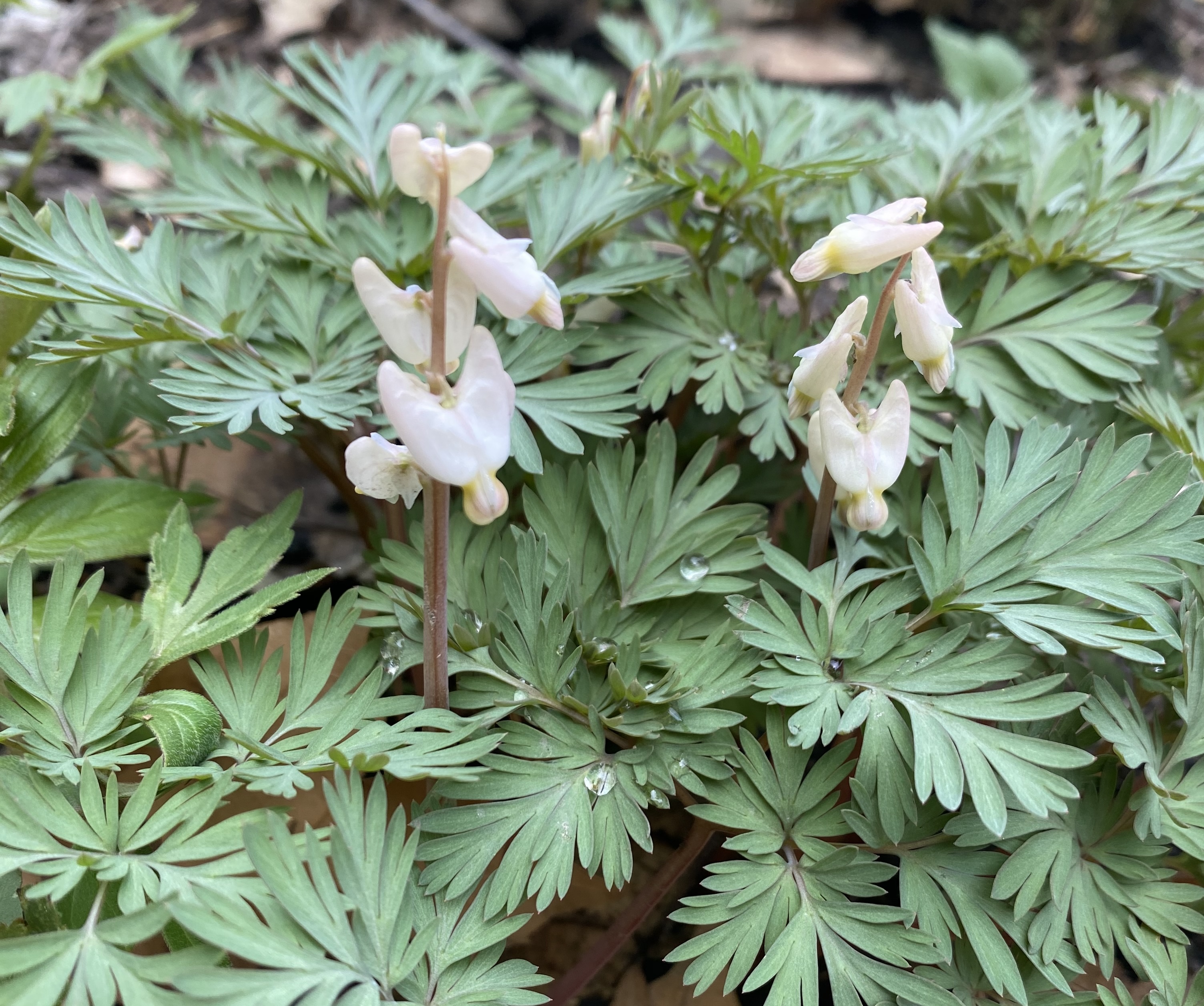
Here in Southern Wisconsin, it’s time to collect Dutchman’s breeches (Dicentra cucullaria) seeds. In my experience, the window of opportunity to collect these seeds is very short, usually from about May 5 to May 15. When the pods are ripe, they will burst open, spilling seeds on the ground. You’ll want to harvest right before this happens, when the pods are swollen and the seeds are visibly bulging (see Figure 1).

If you don’t catch the pods before they burst, fear not—your neighborhood ants will propagate the Dutchman’s breeches for you. Enticed by the nutrient-rich elaiosomes attached to the seeds (see Figure 2), ants will carry the seeds toward their nests, effecting dispersal. This mutualism between plants and ants is called myrmecochory, an arrangement that is very common in the forests of eastern North America; Beattie and Culver reported that 30% of herbaceous species surveyed across ten West Virginia forest sites were myrmecochores.1 Generally speaking, ants will carry seeds back to their nest, eat the elaiosomes, and discard the seeds within the subterranean middens of the ant nest—or on the soil surface nearby—where the seed can germinate.

If you want to grow Dutchman’s breeches yourself, but don’t want to collect the seeds, Prairie Moon sells them in packets of 60. I’ve never tried germinating Prairie Moon’s Dicentra cucullaria, but I expect they would work well.
Once I collect my seed pods, I usually leave them out for a few days, waiting for the pods to burst (see Figure 3). My theory (not yet proven) is that the pods that burst contain more viable seeds, so I sometimes discard any pods that don’t open up on their own. Once the seeds are released, it’s time to immediately begin warm-moist stratification. Although I use sand for most of my cold stratification, I’ve come to favor a 50/50 blend of vermiculite and perlite for warm stratification (but that’s a topic for another post). Moisten the mixture to the point that it is damp, but not soggy (the seeds need 100% humidity, but they don’t want to sit in water). Then throw in your seeds.

I left my seeds in warm stratification for four months, using an alternating day/night temperature regime of 30/15°C (more info on temperature regimes here). I then moved the seeds to the fridge for two months of cold stratification at approximately 4°C. Finally, I decanted my vermiculite/perlite/seed mix on top of a potting medium in a ¼” layer and left them to germinate at an alternating temperature regime of 20/10°C. Cotyledons emerged in approximately two weeks (see Figure 4).

I’ve just begun experimenting with growing this plant in pots, so I’m not sure how it will go. Spring ephemerals can be fickle when grown in containers. I expect that the plants will soon go dormant, and I’ll have to put them back in the fridge for a couple months to break that dormancy and initiate further growth. I’ll report back on results! ■

Have a question? If you have questions about Midwestern native plant propagation that you want answered in a future post, I’d love to hear from you! Shoot me an email at plantpropagationproject@gmail.com or leave a comment below!
Want to stay up to date on all my propagation protocols? Subscribe for free to receive new posts and support Practical Seed Ecology:
Want to support this work? Buy me a cup of coffee (or a bag of potting medium):
Buy me a cup of coffee, a whole bag of coffee, or a whole bag of PRO-MIX BX (my preferred potting medium).
Make a monthly donation
Make a yearly donation
Choose an amount
Or enter a custom amount
Thank you for supporting this project!
Your contribution is appreciated.
Your contribution is appreciated.
Notes
- Andrew J. Beattie and David C. Culver, “The Guild of Myrmecochores in the Herbaceous Flora of West Virginia Forests,” Ecology 62, no. 1 (1981): 107–15, https://doi.org/10.2307/1936674 ↩︎
Leave a Reply