
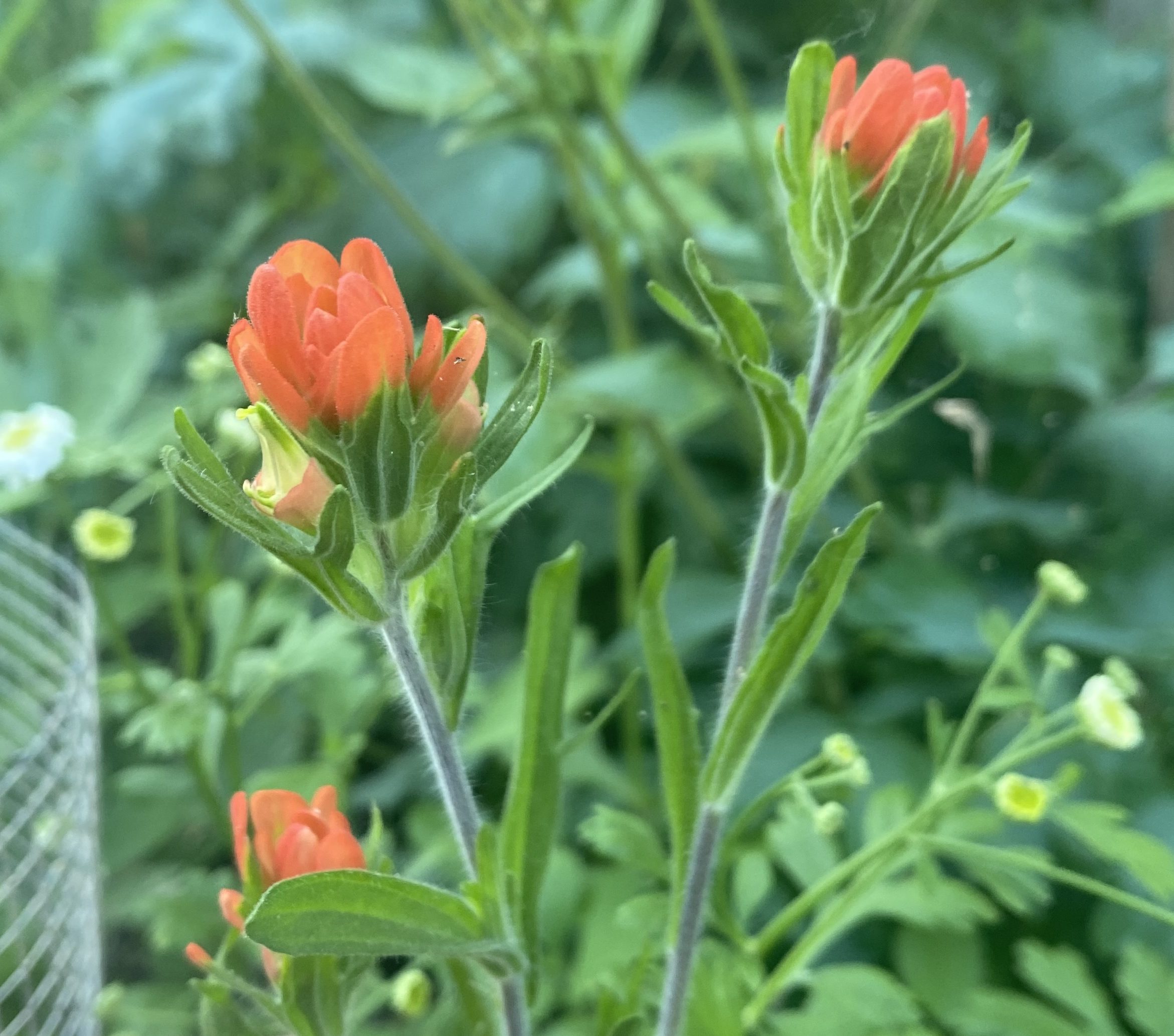
Scarlet painted-cup (Castilleja coccinea) is strikingly beautiful, its bracts—modified leaves that resemble petals—an uncommonly vibrant red that stands out among the yellows, purples, blues, and greens more typical of Midwestern prairies. There are approximately 200 species in the Castilleja genus, the vast majority of which are native to the western half of North America.1 Out west, they are relatively common, and on a recent expedition to the Medicine Bow National Forest in Wyoming, I came across fields and fields of them (see Figure 1), with specimens from many taxa. In Wisconsin, however, it is somewhat rare to stumble upon members of the genus, and we have only two native species: C. coccinea (the topic of this post) and its very demure cousin C. sessiliflora.

Like most members of the Orobanchaceae (broomrape) family, scarlet painted-cup is parasitic, using root-like structures called haustoria to attach to other plant roots and suck out the nutrients. Technically speaking, scarlet painted-cup is a hemiparasite, meaning that it is capable of photosynthesis. This sets it apart from holoparasites—such as ghost pipe (Monotropa uniflora)—that cannot photosynthesize at all.

I’ve never seen scarlet painted-cup for sale as a live plant (only as seed), so I was curious to see if I could grow it successfully. In my experience, it is an annual (though I’ve seen it listed as a biennial), so my plan was to introduce a large number of them to a prairie planting in hopes that it would naturalize. Germinating scarlet painted-cup is not difficult (it germinates readily after a simple six-week cold-moist stratification), but coaxing it to flower is not so straightforward. As a hemiparasite, it can survive—at least for a time—in the absence of a host plant. But in my experience, without a suitable host, it will grow no larger than a small basal rosette, and it will not flower.
Based on the information on Prairie Moon’s website, last year I tried growing my scarlet painted-cup seedlings with three different graminoids (grass-like plants) as hosts: path rush (Juncus tenuis), needle spikerush (Eleocharis acicularis), and Pennsylvania sedge (Carex pensylvanica). All of these host plants were chosen because they were short, which seemed smart, since taller plants would likely overgrow the diminutive scarlet painted-cup seedlings. But my experimentation suggests that these were inappropriate host plants; none of the scarlet painted-cup seedlings grew beyond the basal rosette phase.

So this year I researched a bit more, and it turns out that there is extremely limited academic interest in container culture of scarlet painted-cup. Zaster, in their 1984 master’s thesis, noted high survival (albeit not statistically significant) of scarlet painted-cup when grown with the ‘Golden Moss’ cultivar of feverfew (Tanacetum parthenium). I happened to have a different cultivar of feverfew, ‘Tetra White’, on hand, so I decided to test how scarlet painted-cup would perform with feverfew as a host. Note that, although there is a native feverfew (Tanacetum bipinnatum), Tanacetum parthenium is a Eurasian native. So it’s definitely not an ideal host plant if you’re growing for a native planting. But I was desperate and willing to try anything.
In addition to the feverfew, I also tested blue grama (Bouteloua gracilis), which is a very short grass. Blazing Star Nursery uses blue grama as a host for the hemiparasite Pedicularis canadensis, so I figured it was worth a try.
When the seedlings were growing in their plugs, the results of my experiment seemed clear. Scarlet painted-cup seedlings grown with the feverfew were much larger (see Figure 4). But when I planted them out, the picture became more complicated. The seedlings planted with feverfew continued to thrive, but the seedlings planted with blue grama started to catch up. As of July 2, two of the plants grown with feverfew are in bloom, as well as two of the plants grown with blue grama. So it appears that scarlet painted-cup is capable of parasitizing both plants.


It’s worth noting that this experiment was not rigorously designed, and it was poorly controlled. My sample groups were very unequal in size: I grew four seedlings with feverfew, but about ten with blue grama. Of the four grown with feverfew, 100% produced a flower spike (but one spike died, and one hasn’t yet bloomed). Of the ten grown with blue grama, only two have produced flower spikes thus far. So it does appear that feverfew might yield greater rates of flower stalk production. Additionally, once plants are in the field, I cannot control what they parasitize. I’ve noticed that the flowering specimens growing with blue grama are also surrounded by a common native weed: wood sorrel (Oxalis stricta). So it is possible that they’re parasitizing the wood sorrel.
The good news is that it seems like growers could find success with either of these two host plants. My advice is to plant out many scarlet painted-cup seedlings to hedge your risk. They seem to be sensitive to location (none of the plants from part shade areas produced flower spikes), so plant them in many different places and find out where they thrive.
Next year I’ll test a wider variety of hosts, and I’ll also test a few purely in my greenhouse to try to minimize confounding variables. Stay tuned! ■
Have a question? If you have questions about Midwestern native plant propagation that you want answered in a future post, I’d love to hear from you! Shoot me an email at plantpropagationproject@gmail.com or leave a comment below!
Want to stay up to date on all my propagation protocols? Subscribe for free to receive new posts and support Practical Seed Ecology:
Want to support this work? Buy me a cup of coffee (or a bag of potting medium):
Buy me a cup of coffee, a whole bag of coffee, or a whole bag of PRO-MIX BX (my preferred potting medium).
Make a monthly donation
Make a yearly donation
Choose an amount
Or enter a custom amount
Thank you for supporting this project!
Your contribution is appreciated.
Your contribution is appreciated.
Notes
- According to Kew’s Plants of the World Online database. ↩︎


Leave a Reply