
This website is intended to help you grow less-commonly-propagated plants, with an emphasis on those native to the American Midwest. If you’re not familiar with the term less-commonly-propagated plant, that’s probably because I made it up. I use this term to indicate that these plants are uncommon in the nursery trade, even if they aren’t necessarily rare in “the wild” (though some of them are).
Because these less-commonly-propagated plants are seldom offered by nurseries, many of them are almost entirely absent from urban landscapes. Here in Madison, Wisconsin, I almost never seed Pedicularis canadensis, Castilleja coccinea, Gentianella quinquefolia, or Lilium philadelphicum in folks’ gardens, despite the fact that they are native to the area (and very showy).
There are many reasons that nurseries don’t often carry the less-commonly-propagated plants that I’m so fond of. I don’t operate a nursery, so my opinions should be taken with a grain of salt, but I hypothesize that nurseries are motivated by:
- Low demand for native plants that are annuals, biennials, and short-lived perennials. A lot of the rhetoric that circulates in native plant circles is couched in the language of investing in the future. Native plant enthusiasts will assure you that native plants may look anemic their first year (or two), but they’ll eventually be large, and live for years (or decades) to come. So that puts short-lived natives like Gentianella quinquefolia and Castilleja coccinea in an awkward position. If planting natives is about investing in the future, perhaps there isn’t so much appetite to shell out money for a plant that won’t come back next year, and is not guaranteed to reproduce.
- Logistical issues in propagation. There are a range of logistical issues that arise with certain native plants. Some natives grow very slowly, taking years to be large enough to sell (e.g., Lilium michiganense). Others, like hardy orchids, require lab conditions to germinate and keep alive. Pedicularis canadensis – along with many of its Orobanchaceae brethren – is a hemiparasite, requiring a suitable host species to thrive. And some plants are simply very difficult to keep alive in a greenhouse setting; Gentiana puberulenta immediately comes to mind.
- A lack of suitable cultural conditions in typical garden settings. Nurseries would rather sell you a plant that you can keep alive easily. For that reason, nurseries are less likely to sell plants that require sophisticated site selection or bed preparation. The obvious examples here would be species that prefer bogs (e.g., carnivorous plants and hardy orchids) and those that prefer barrens (such as northern cacti).
- A need to reduce redundant offerings. It’s not really feasible to offer every species in a genus, especially if they look fairly similar. There are, for instance, well over 100 species in the Carex genus of sedges that are native to Wisconsin. But since many of them look similar and grow in similar conditions, it’s understandable that nurseries don’t want to overwhelm customers with a huge number of choices.
- Consumer preference for “tamer” plants. I learned this the hard way when I sold Cirsium discolor (Pasture thistle) last year. I thought these plants would sell themselves, given that they are a preferred source of food and fluff for finches. Turns out nobody wanted them, and people even told me they were “better off left in the wild.” So it would seem that folks are less likely to select plants with that wilder look, whether that means prickles, a gangly habit, or inconspicuous flowers.
If you’re like me, and you like growing native plants that are difficult to find at nurseries, you’ve probably tried your hand at starting plants from seed. When I started growing less-commonly-propagated plants, I quickly found out that much of the information available on the internet is either incomplete or wrong. So I put together this website, which I intend to be a trusted source of information on growing these special plants. I hope you find it useful!
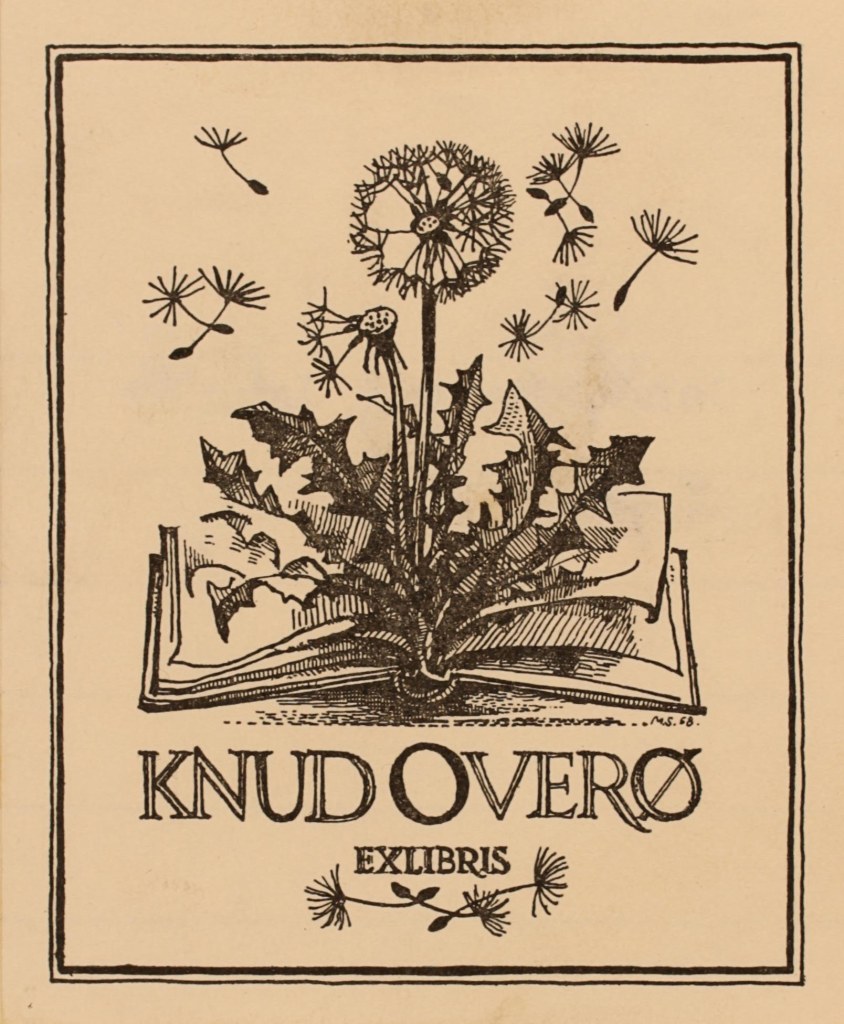
Where did you get that cool image on your homepage?
That image is, in fact, part of a bookplate designed in 1958 by Mads Stage for Knud Overø (see full design below).
 Practical Seed Ecology